
From press-to-talk radio to hands-free, simultaneous team communication.
In heavy industry, mining, construction and industrial maintenance, communication is more than exchanging messages. It is a critical part of real-time coordination.
When a team is operating heavy machinery, positioning a large structure or troubleshooting equipment, several people may need to speak at the same time.
Conventional two-way radio systems are valuable and widely used. But most traditional PMR and DMR talk-group configurations are half-duplex: one person transmits while others listen.
Full-duplex Mesh communication introduces a different way of working.
1. The Limitation of Conventional PMR and DMR
In conventional half-duplex radio communication, a worker presses Push-to-Talk (PTT), speaks, releases the button and waits for a response.
VOX can activate transmission automatically when speech is detected, removing the need to physically press PTT.
However, VOX does not change the underlying half-duplex communication model. Only one user normally transmits on the shared talk channel at a time.
For routine communication, this is often sufficient.
For teams carrying out tightly coordinated operations, it can create unnecessary delays.
Imagine a crane operator, a signal person and two workers positioning a heavy component. If someone identifies a problem while another person is transmitting, they may need to wait for the channel to become available.
That limitation is not necessarily a failure of conventional radio. It is a consequence of the communication architecture.
2. Full-Duplex Mesh: Hands-Free Communication Without Taking Turns
Full-duplex communication allows users to speak and listen simultaneously.
In a multi-user full-duplex Mesh system, several team members can participate in an ongoing conversation without repeatedly pressing PTT or waiting for another person to finish speaking.
This offers four important advantages:
- Hands-free operation. Workers can keep both hands available for tools, equipment and operational tasks.
- Simultaneous communication. Multiple team members can speak and listen without the conventional one-speaker-at-a-time restriction.
- Immediate coordination. Workers can respond naturally during time-sensitive operations.
- Reduced operational friction. Communication becomes part of the team’s workflow rather than a sequence of radio transmission turns.
These benefits are particularly relevant to heavy industry, mining, construction and maintenance.
Full duplex is not exclusive to Mesh technology. However, combining full-duplex audio with a suitable Mesh network architecture can be particularly useful for mobile industrial teams.
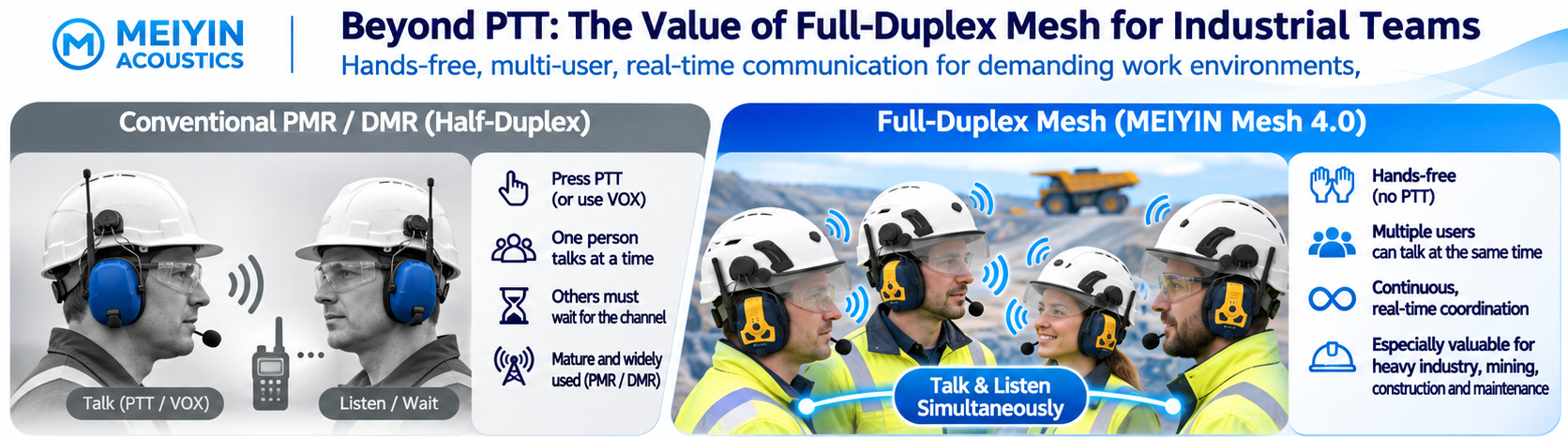
Figure 1. Half-duplex radio versus hands-free, multi-user full-duplex Mesh communication.
3. Why Industrial Mesh Requires More Than a Radio Module
DMR is a standardised digital radio technology with defined technical specifications.
Mesh is different. It describes a networking approach, not a single universal industrial voice communication protocol.
Different manufacturers may use different wireless waveforms, networking mechanisms and proprietary communication protocols.
As a result, products described as Mesh are not necessarily interoperable.
Developing a practical industrial voice Mesh system requires coordinated engineering across multiple layers, including:
- Device discovery, joining and network formation
- Group management and communication sessions
- Real-time audio transport and packet scheduling
- Multi-user voice handling
- Relay, routing and network recovery
- Synchronisation, latency and RF resource management
Existing hardware and software components can be reused where appropriate. But an industrial Mesh system cannot be reduced to simply adding a standard radio module or a voice codec.
The application layer, networking mechanisms and wireless communication system must work together.
4. Not All Mesh Solutions Are the Same
The term Mesh is widely used, but different technologies offer very different communication experiences.
Bluetooth Mesh and Bluetooth Intercom
Bluetooth Mesh is primarily designed for device networking and message exchange rather than continuous, low-latency group voice.
Bluetooth headset intercoms are a separate category. Depending on their implementation, they may involve limited group sizes, shorter practical communication distances and manual connection management.
Bluetooth Mesh and conventional Bluetooth intercom should therefore not be treated as identical technologies.
Consumer-Derived Mesh
Consumer-derived Mesh systems, including technologies developed for motorcycle group communication, can offer substantial improvements over conventional Bluetooth intercoms.
Some support long-range links, multi-user full-duplex conversations and relay functionality.
In suitable implementations and conditions, communication distances may reach approximately 500–800 metres per link.
The main industrial limitation is not necessarily range or the ability to support simultaneous conversations.
It is often the connection experience.
Systems that require pre-pairing, manual group creation or repeated setup can be inconvenient when workers change shifts, join different teams or move between work areas.
MEIYIN Mesh 4.0
MEIYIN Mesh 4.0 focuses on industrial usability while retaining the advantages of long-range, multi-user full-duplex communication.
Its key characteristics include:
- Long-range wireless communication: approximately 500–800 metres per link, demonstrated under tested operating conditions.
- Multi-hop relay: support for 2–3 relay hops, allowing communication to extend through intermediate network devices where the topology and radio conditions permit.
- Ready at power-on: designed for immediate team communication without manual device-to-device pairing.
- Multi-user full-duplex operation: several team members can speak and listen simultaneously.
- The distinction is important: consumer-derived Mesh and industrial Mesh can offer similar headline communication capabilities, but their deployment workflows and operational priorities may be very different.
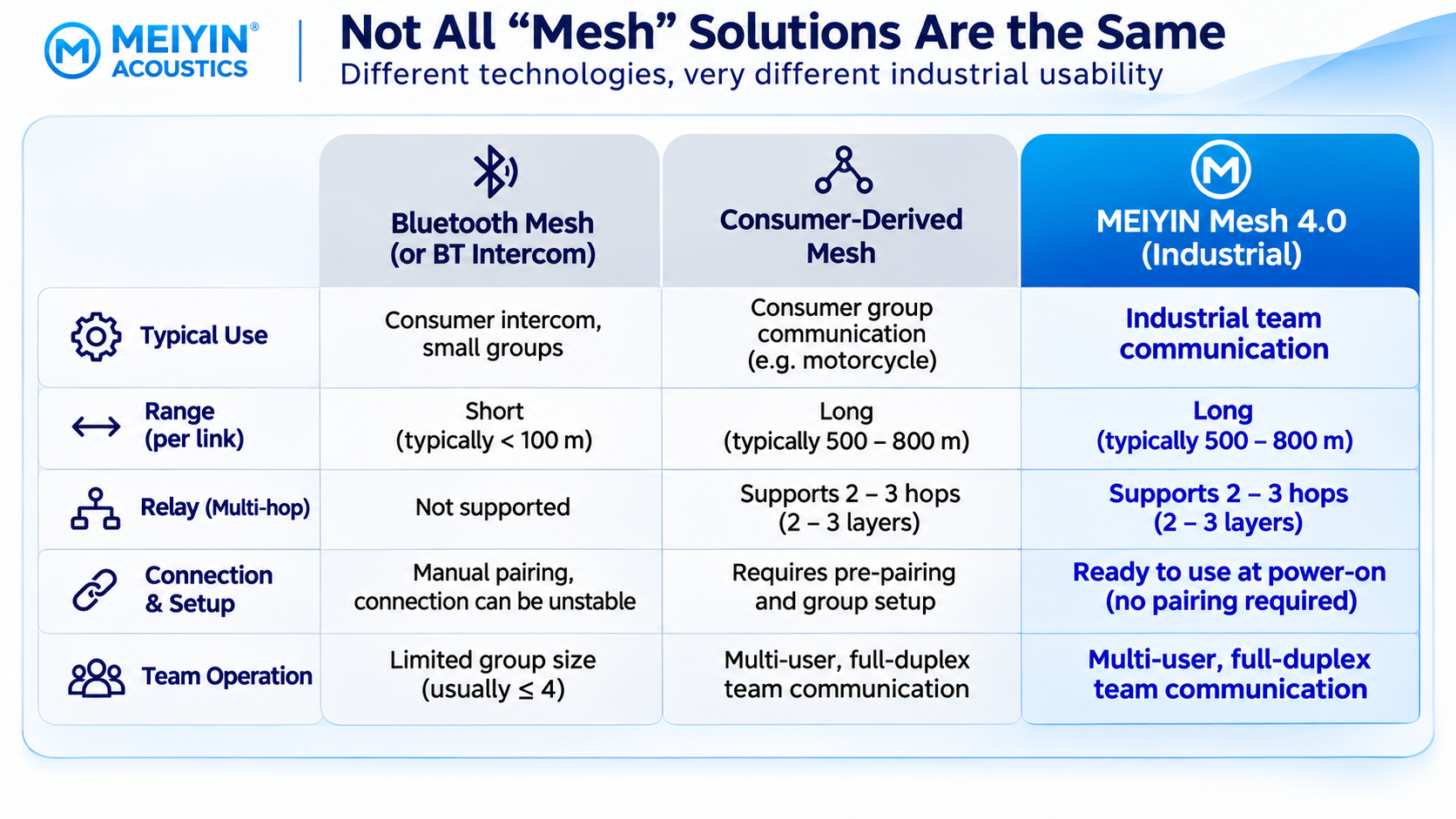
Figure 2. Comparing Mesh technologies by communication range, relay capability, connection setup and team operation.
5.MEIYIN Mesh 4.0: OFDM-Based Industrial Wireless Communication
MEIYIN Mesh 4.0 uses an OFDM-based wireless architecture.
OFDM, or Orthogonal Frequency-Division Multiplexing, transmits data using multiple orthogonal subcarriers. It provides a flexible technical foundation for digital wireless communication.
However, OFDM alone does not create a reliable industrial Mesh system.
Actual performance depends on RF design, receiver sensitivity, antennas, interference management, packet scheduling, network protocols and the operating environment.
500–800 Metres: Tested Communication Distance
MEIYIN Mesh 4.0 has demonstrated communication distances of approximately 500–800 metres per wireless link under tested conditions.
The design also considers applicable regional constraints on transmitter power, power spectral density (PSD) and spectrum use.
Actual range depends on the frequency configuration, antenna arrangement, obstacles, interference and site conditions.
The tested distance should not be interpreted as guaranteed coverage in every industrial environment, particularly underground mines, enclosed steel structures or heavily obstructed facilities.
2–3-Hop Relay Capability
MEIYIN Mesh 4.0 supports 2–3 relay hops.
Intermediate devices can forward communication traffic, enabling a network to reach users beyond a direct radio link when the network topology allows.
Multi-hop capability is particularly relevant to mobile teams working across large or partially obstructed sites.
However, end-to-end coverage is not simply the single-link distance multiplied by the number of hops. Relay performance depends on network geometry, radio conditions, latency and traffic load.
Power On and Communicate
In industrial environments, the time required to establish communication matters.
A system that requires workers to manually pair devices or reconstruct communication groups can introduce unnecessary operational complexity.
MEIYIN Mesh 4.0 is designed for communication to become available when devices are powered on, without manual device-to-device pairing.
This supports more practical operation across changing crews and work shifts.
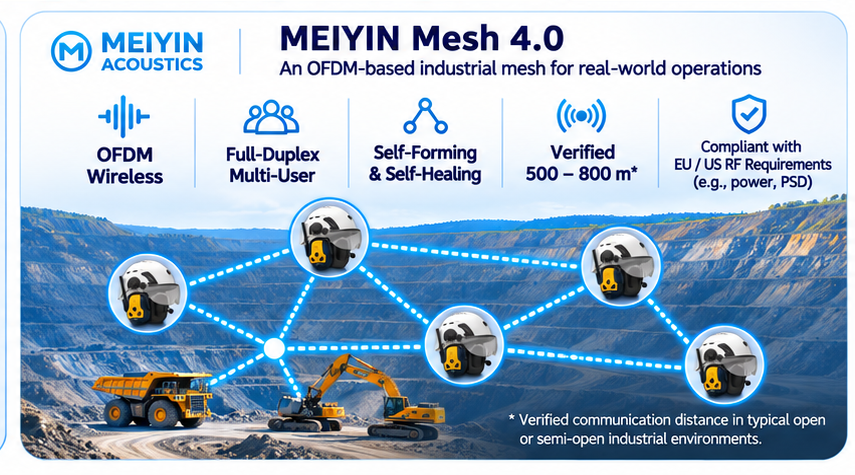
Figure 3. MEIYIN Mesh 4.0 industrial wireless architecture, featuring OFDM, full-duplex communication and multi-hop networking.
6. Where Full-Duplex Mesh Matters Most
The practical benefits become especially clear in industries where communication must occur alongside physical work.
- Heavy industry and steel production: workers coordinating cranes, moving equipment and large components need immediate communication while keeping their hands available.
- Mining and quarrying: equipment operators, maintenance teams and mobile crews can benefit from continuous communication. Underground or highly obstructed environments require separate site-specific coverage validation.
- Construction and lifting operations: multiple workers can exchange instructions and warnings without waiting for a shared radio channel.
- Industrial maintenance: technicians can discuss measurements, observations and troubleshooting steps while working on equipment.
- Shipyards and large industrial facilities: teams moving between work areas can benefit from simplified joining and network recovery.
Of course, wireless communication is only part of the solution.
Speech intelligibility, microphone performance, hearing protection, battery life and suitable environmental protection remain essential.
Full-duplex communication does not replace established safety procedures or dedicated emergency systems.
7. Beyond PTT: A Different Communication Experience
Traditional PMR and DMR systems remain valuable for many professional radio applications.
Full-duplex Mesh serves a different operational need: continuous, simultaneous communication among workers who cannot afford to manage every conversation through PTT.
Consumer-derived Mesh technologies have already demonstrated the value of long-range, multi-user wireless intercoms.
For industrial use, the next challenge is to make these capabilities simpler to deploy, easier to operate and more suitable for demanding work environments.
With its OFDM-based wireless architecture, tested 500–800 m communication distance, 2–3-hop relay capability and no-manual-pairing operation, MEIYIN Mesh 4.0 reflects this industrial engineering direction.
The objective is not simply to connect more headsets.
It is to allow industrial teams to communicate naturally, continuously and hands-free — while keeping their attention on the work.
If you have any questions, suggestions, or insights regarding Mesh communication technology, we welcome your feedback and discussion.
Please feel free to contact us at hua@njmyat.com or sales1@njmyat.com.
Written by Mark Hua
MEIYIN Acoustics
Hearing Protection Engineering | Industrial Communication | OEM/ODM Development
