
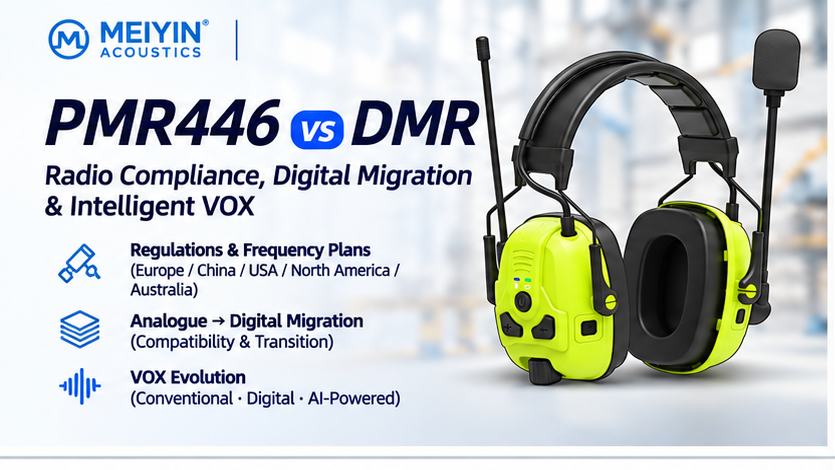
PMR446 and DMR are often treated as competing choices when specifying an industrial communication earmuff. But they do not describe the same thing. PMR446 is a European licence-exempt radio application with defined equipment and operating restrictions; DMR is a digital radio standard. A communication earmuff must be designed around the intended market, network, user workflow and acoustic environment—not around a label alone.
1. Start with the radio application, not the acronym
In Europe, PMR446 operates in the 446.0–446.2 MHz band under specific licence-exempt conditions, including a maximum of 500 mW ERP and integral antennas. The applicable rules also restrict repeaters and certain transmission behaviours. These conditions must be checked against the relevant current national and European requirements.
DMR, by contrast, defines a digital radio air interface. Digital operation does not automatically mean licensed operation: DMR Tier I equipment may be designed for applicable licence-exempt PMR446 use, while other DMR implementations serve licensed professional networks.
The practical questions are therefore separate: which frequency allocation is permitted, whether the application is licence-exempt or licensed, whether the fleet uses analogue FM or digital radio, and what interoperability is required.
2. Regional compliance is a product-design requirement
A European PMR446 design cannot simply be assumed to be suitable for every country. China, for example, has a different public walkie-talkie frequency allocation in the 409.75–409.99 MHz range. Regulatory frameworks also differ in the United States, Canada and Australia.
Changing the programmed frequency alone is not sufficient. Antenna design, radiated power, spectral limits, equipment approval and permitted operating modes may all be affected. Analogue FM is not universally prohibited in China; regulatory treatment depends on the radio category and applicable rules.
For OEM/ODM projects, the target markets should be defined before the RF architecture is frozen.
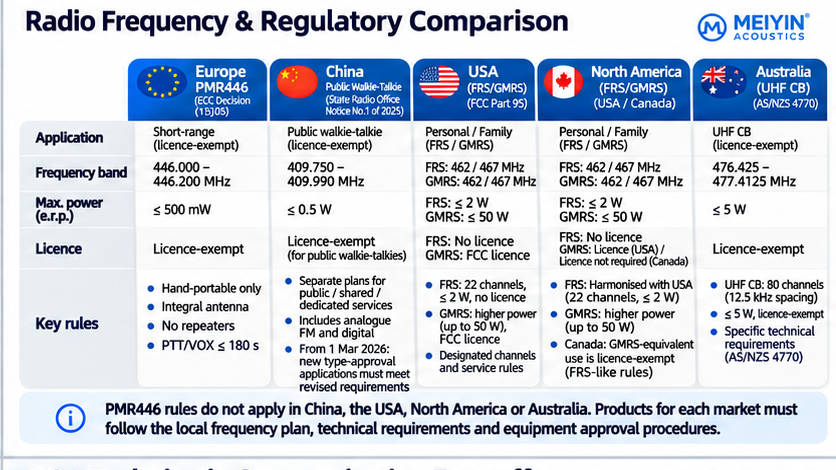
frequency plans.
3. Plan for analogue-to-digital migration
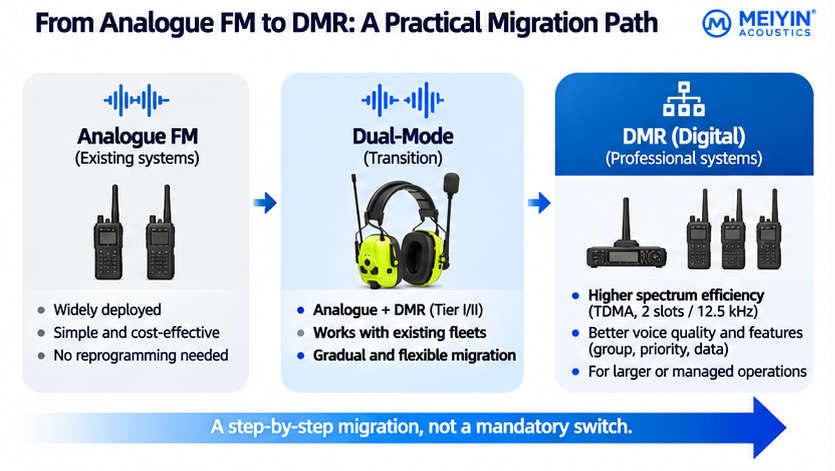
Many industrial fleets still contain analogue radios. A sudden replacement of every device is often impractical. Where supported, dual-mode equipment can help manage a transition between analogue FM and DMR, but actual interoperability must be checked against the installed fleet, channel plan and feature requirements.
DMR Tier II uses two-slot TDMA on a 12.5 kHz channel. Digital systems can offer operational benefits, but also introduce vocoder behaviour, compatibility considerations and a different coverage experience: intelligible audio may deteriorate abruptly near the edge of digital reception.
Migration planning should therefore consider mixed fleets, user training, infrastructure, coverage testing and the life cycle of existing equipment.
4. A radio inside an earmuff is a different engineering problem
A communication earmuff combines RF engineering, hearing protection, speech capture and human factors in a compact wearable product.
The antenna operates close to the head, helmet and surrounding metal structures. Microphones must capture useful speech in machinery noise. Radio audio, environmental listening and optional Bluetooth audio must be prioritised and mixed appropriately. Battery capacity must support the expected shift while preserving wearability.
Most importantly, internal audio output and acoustic exposure must be engineered against the applicable hearing-protection and communications standards. Radio performance alone is not a complete product specification.
5. VOX is not one technology
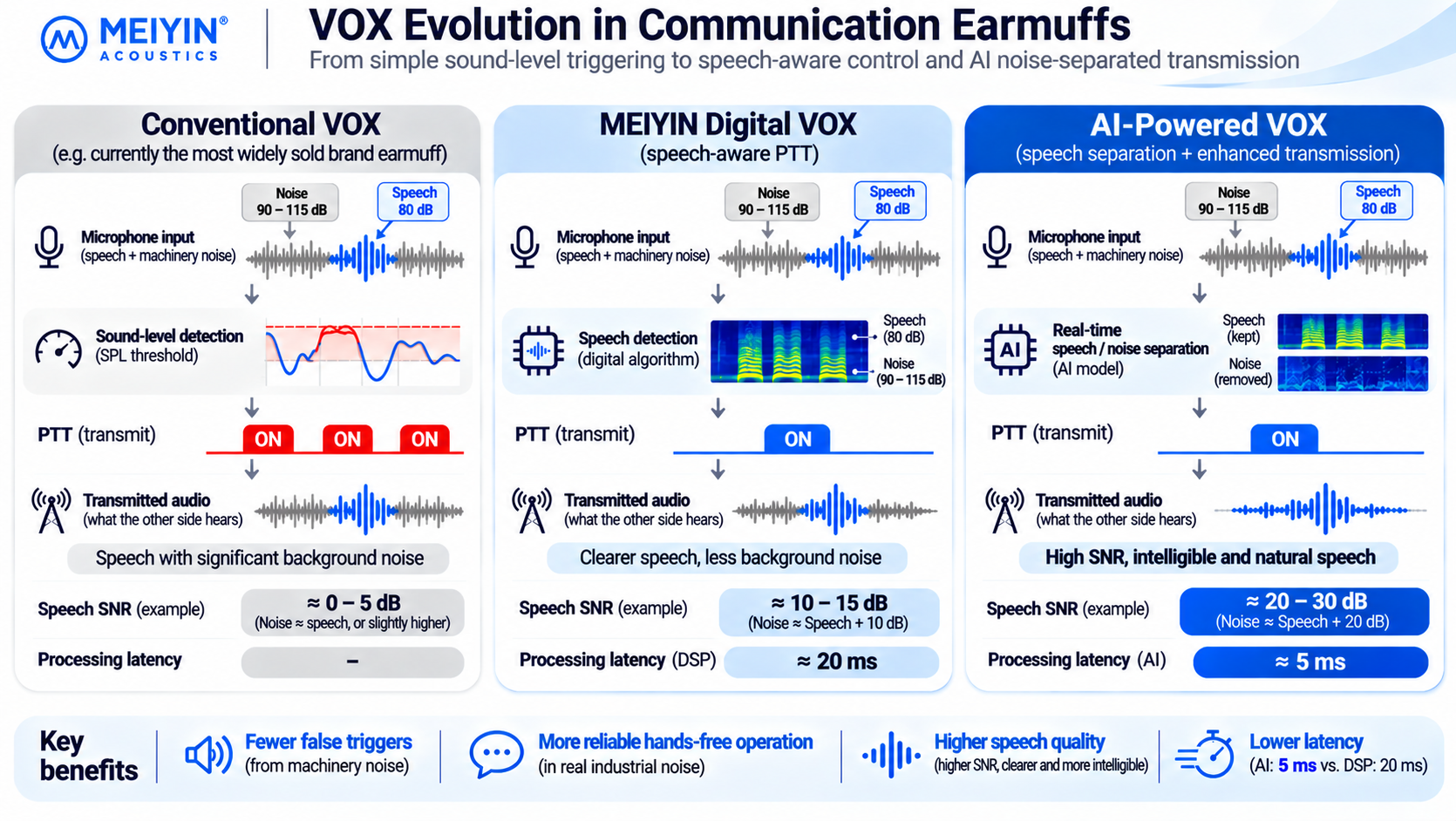
Hands-free transmission is valuable when workers cannot safely reach a PTT button. But conventional sound-level-triggered VOX can respond to machinery noise as well as speech, depending on its implementation and environment.
Conventional VOX: A threshold-based approach detects microphone activity and may trigger unintentionally in high ambient noise. This is a generic architecture description, not a claim about any competitor’s proprietary implementation.
MEIYIN Digital VOX: Speech-oriented digital signal processing can be used to make the transmit decision more selective. Detecting speech for PTT control does not, by itself, establish that the transmitted audio has been noise-reduced.
AI-powered VOX: An AI speech/noise separation approach can potentially support both speech-aware transmission control and cleaner transmitted speech. Performance must be evaluated at defined input SNRs, processing latency and complete system latency.
For example, speech at 80 dB with surrounding noise at 90 dB corresponds to an input speech-to-noise ratio of −10 dB. Noise at 100 dB corresponds to −20 dB. These are input conditions, not positive output-SNR improvements.
6. Questions to settle before selecting a communication earmuff
- Which countries and radio regulatory categories will the product serve?
- Is the installed fleet analogue, digital or mixed?
- Does the use case require PTT, VOX or both?
- What noise conditions, helmets and working postures must be supported?
- What are the requirements for RF coverage, battery life, audio routing and hearing safety?
- Which approvals and field tests are needed for the final configuration?
Conclusion
The first question should not be simply “PMR or DMR?” It should be: What communication architecture will work safely, legally and reliably for this industrial team?
At MEIYIN Acoustics, we approach communication earmuffs as integrated acoustic, RF and industrial design systems, with OEM/ODM development guided by the actual application.
Written by Mark Hua MEIYIN Acoustics Technology Co., Ltd. For technical discussions or OEM/ODM cooperation: hua@njmyat.com | sales1@njmyat.com
