
Two electronic hearing protectors may comply with the same applicable EN 352 requirements and still deliver noticeably different listening experiences.
One may reproduce speech naturally, with minimal audible delay. Another may sound compressed, artificial or difficult to understand in industrial noise.
Why? Because compliance and sound quality answer different engineering questions.
For level-dependent earmuffs, EN 352-4 addresses safety-related performance, including criterion levels. It does not prescribe one universal signal-processing architecture or guarantee identical perceived sound quality.
The difference often lies in how the incoming sound is captured, processed and reproduced.
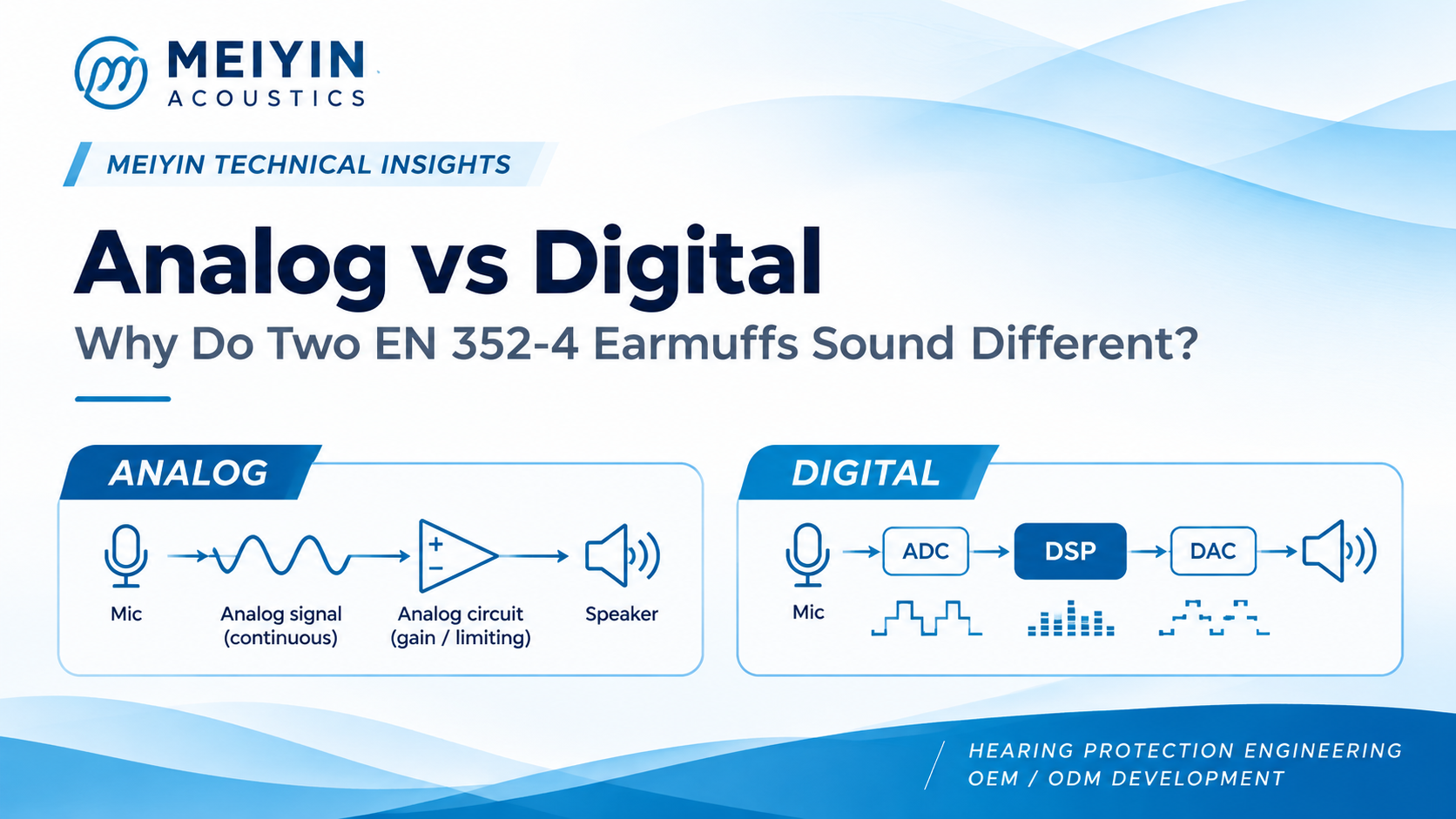
1. Analogue and Digital Earmuffs Follow Different Signal Paths
A conventional analogue level-dependent earmuff may use a relatively direct signal path:
Microphone → Analogue Gain / Limiting → Speaker
A digital system typically introduces conversion and digital signal processing:
Microphone → ADC → DSP → DAC → Speaker
Both architectures can be engineered to meet applicable safety requirements. However, they may differ in latency, filtering, dynamic-range control, distortion, power consumption and the way they reproduce speech and environmental sound.
Neither architecture is automatically superior in every application.
The analogue and digital signal paths are illustrated in the cover image above.
2. Safety Limits Do Not Define the Entire Listening Experience
A frequently discussed reference in hearing-protection engineering is 82 dB(A). However, it is important to distinguish different regulatory and acoustic concepts.
For level-dependent earmuffs, EN 352-4:2020 specifies requirements related to criterion levels, including H, M and L values. These are not equivalent to a universal 82 dB output limit for every product.
Other members of the EN 352 family address different types of audio input and output, with requirements and reporting methods specific to their applications.
Therefore, two products should not be compared solely by saying that both meet an “82 dB criterion.”
A more useful technical comparison examines the applicable standard, measured criterion levels, attenuation performance, audio output characteristics and listening behaviour under representative noise conditions.
3. Why Natural Sound Is Difficult to Reproduce
Natural hearing depends on much more than sound pressure level. The auditory system uses timing, spectral information, spatial cues and changes in amplitude to interpret the environment.
An electronic earmuff must capture external sound through microphones, process it and reproduce it inside an acoustically isolated earcup. Every stage can change the listening experience.
Frequency response. Uneven amplification may make speech sound thin, muffled or excessively bright.
Dynamic-range processing. Aggressive limiting or compression may reduce level differences that help listeners distinguish environmental events.
Latency. Delayed reproduced sound may interact with residual acoustic sound entering through the protector, potentially creating audible coloration.
Microphone placement. External microphones do not receive sound in exactly the same way as the unaided human ear.
Processing artefacts. Filtering, quantization, noise reduction and other processing operations can introduce audible changes if not carefully implemented.
Natural sound therefore requires system-level acoustic engineering rather than simply adding a more powerful DSP.
4. Latency Matters — but the Measurement Point Matters Too
Digital processing introduces delay, although the amount depends heavily on the architecture and algorithm.
A quoted DSP delay of approximately 20 ms and a reported AI model-processing delay of approximately 5 ms are not necessarily comparable measurements. They may refer to different stages, implementations and test conditions.
Processing latency must be distinguished from total microphone-to-speaker latency, which also includes conversion, buffering and other system delays.
For meaningful comparisons, engineers should specify the measurement points, processing configuration, sample rate and complete signal path.
Low latency is valuable, but latency alone does not determine speech intelligibility or naturalness.
5. Speech Intelligibility Is a Signal-to-Noise Problem
Consider an industrial environment with:
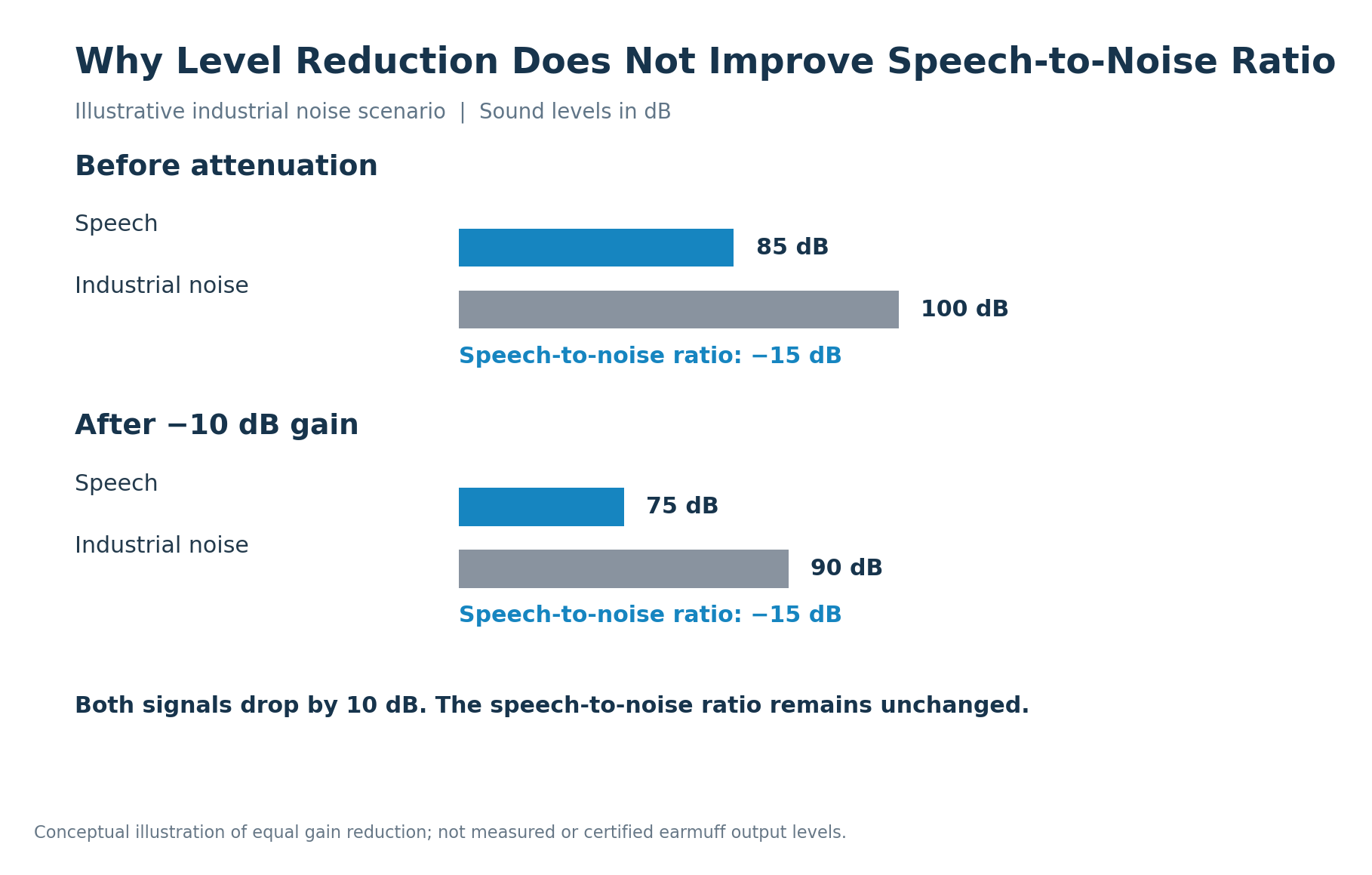
- Background noise: 100 dB
- Speech level at the microphone: 85 dB
The approximate input speech-to-noise ratio is:
SNR = 85 − 100 = −15 dB
In this example, noise is 15 dB louder than speech.
Simply amplifying the microphone signal increases both speech and noise. It does not improve their ratio.
This is why acoustic design, microphone directionality, signal processing and noise separation are important.
Digital filtering may help in selected conditions, but conventional processing has limitations when speech and noise overlap in frequency and time.
AI-based speech separation introduces additional possibilities by attempting to identify speech content and suppress competing noise.
However, improvements should be evaluated using measured speech intelligibility, output SNR, processing artefacts and latency—not just subjective demonstrations.
Here, speech SNR must not be confused with the SNR single-number attenuation rating used for hearing protectors.
6. Why Two Compliant Products Can Still Sound Different
Two hearing protectors may achieve their required safety-related performance while making different design choices.
One may prioritise low latency and a simple analogue signal path. Another may use digital processing for frequency shaping, adaptive gain control or other acoustic functions. A third architecture may incorporate AI-based speech and noise analysis.
Each approach introduces trade-offs involving sound quality, battery life, computational requirements, cost and mechanical integration.
For industrial users, these differences can affect communication comfort, environmental awareness and the perceived usefulness of level-dependent listening.
Compliance establishes essential requirements. It does not eliminate the need for application-specific acoustic evaluation.
7. The Next Step: Intelligent Acoustic Processing
The next generation of hearing protection is increasingly concerned with understanding sound content, rather than responding only to sound level.
An intelligent system may need to distinguish among:
- Continuous machinery noise
- Human speech
- Safety alarms
- Impulsive acoustic events
These sound classes may require different processing priorities.
AI-based noise separation and speech enhancement offer a promising development direction, particularly where conventional filtering cannot adequately distinguish speech from competing noise.
At MEIYIN Acoustics, we see the development of low-latency, embedded acoustic intelligence as an important area for future hearing-protection systems.
The engineering challenge is to integrate these capabilities without compromising the applicable safety requirements, power budget or practical usability of the device.
Conclusion
The question is not simply whether an electronic earmuff is analogue or digital.
The more important question is how effectively its complete acoustic architecture balances hearing safety, natural sound, speech intelligibility, latency and real-world industrial performance.
Two products may meet the same applicable standard and still sound very different. Understanding why is where acoustic engineering creates value.
Written by Mark Hua MEIYIN Acoustics Technology Co., Ltd. For technical discussions or OEM/ODM cooperation: hua@njmyat.com | sales1@njmyat.com
